
CRM is like hiring a business partner.” The right one can simplify your sales process, help you manage your team and improve customer relations. It can end up in the team having to pay for software that they don’t really use.
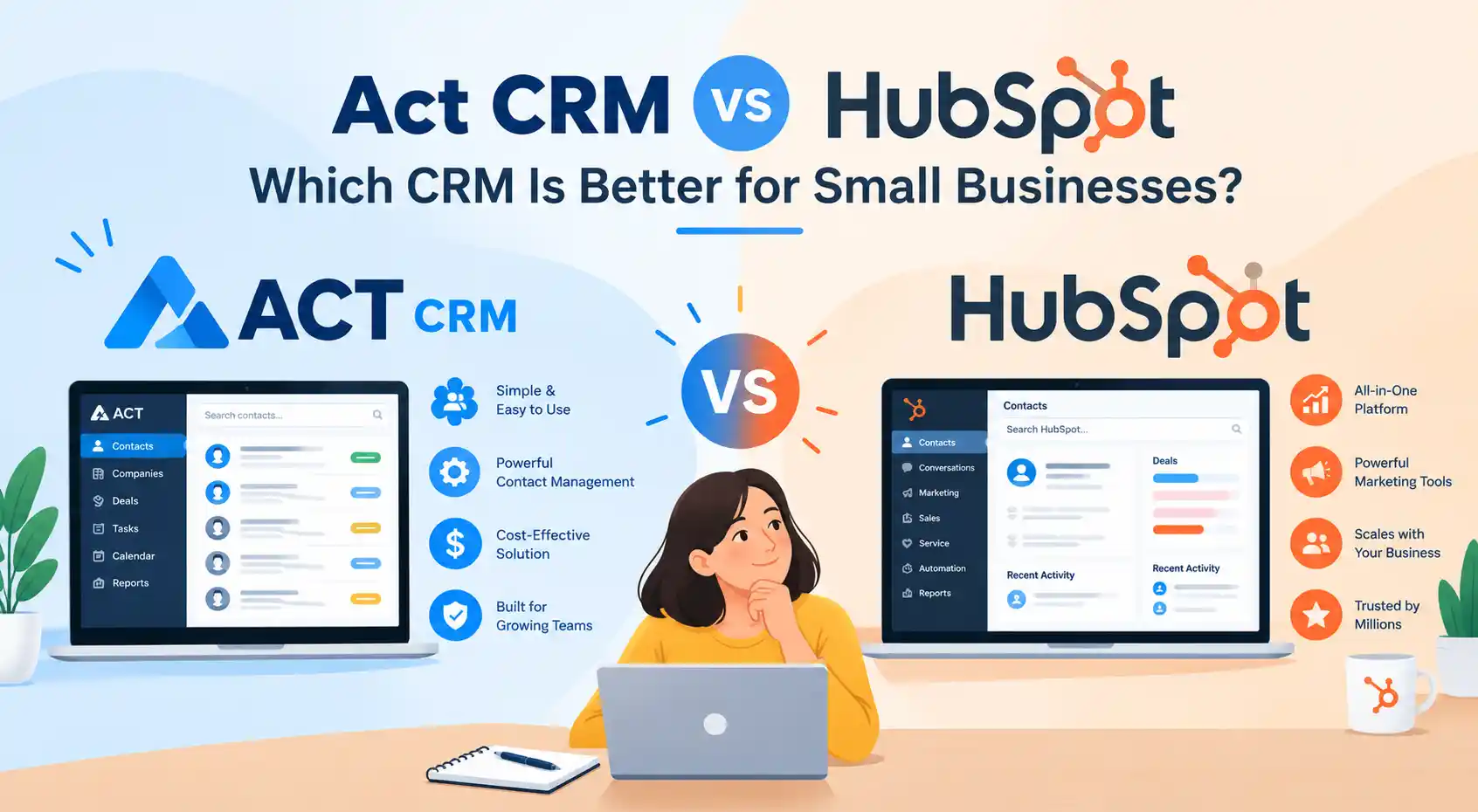
If you’ve been comparing Act CRM vs HubSpot, you’re probably trying to figure out which platform actually fits a small business budget and workflow — not just which one has the flashiest marketing page. Both tools are popular, both have loyal users, and both claim to be “built for growing businesses.” But they’re built on very different philosophies.
This guide breaks down the real differences between Act CRM and HubSpot so you can make a decision based on facts, not just sales pitches.
A Quick Overview of Both Platforms
Before diving into the comparison, it helps to understand what each CRM was originally designed to do.
What Is Act CRM?
Act CRM (formerly Act!) has been around since the late 1980s, making it one of the oldest CRM tools still actively used today. It’s built primarily for contact and relationship management, with a strong focus on:
- Detailed contact and customer history tracking
- Email marketing integration
- Simple sales pipeline management
- On-premise or cloud-hosted deployment options
Act CRM tends to appeal to small businesses that want a straightforward, no-frills system without a steep learning curve.
What Is HubSpot?
HubSpot began as a marketing automation platform before evolving into a comprehensive CRM solution that brings together sales, marketing, customer service, and operations. It is well known for:
- A free-forever CRM tier
- Marketing automation and landing pages
- Deep reporting and analytics dashboards
- A large ecosystem of integrations and apps
HubSpot is often the go-to choice for businesses that want marketing and sales tools combined under one roof.
Act CRM vs HubSpot: Feature Comparison
1. Ease of Use
Act CRM has a more traditional, desktop-style interface. It’s straightforward once you learn it, but it can feel dated compared to modern SaaS tools.
HubSpot, on the other hand, is known for its clean, modern dashboard. New users typically get comfortable within a day or two, which matters a lot for small teams without dedicated IT support.
Winner for beginners: HubSpot, thanks to its intuitive design.
2. Pricing Structure
Pricing is often the deciding factor in the act vs hubspot debate, especially for budget-conscious small businesses.
- Act CRM typically charges a flat monthly fee per user, with pricing scaling based on the number of contacts and add-on features like email marketing.
- HubSpot offers a free CRM with basic features, but costs rise quickly once you need marketing automation, custom reporting, or larger contact limits.
For very small teams or solo entrepreneurs, HubSpot’s free tier can be attractive initially. But businesses that need more advanced automation often find Act CRM more predictable and cost-effective long-term, since its pricing doesn’t balloon as quickly with added features.
3. Sales Pipeline Management
Both platforms offer visual pipeline tools, but they differ in depth:
- Act CRM focuses on simplicity — you get clear stages, easy drag-and-drop deal tracking, and solid contact history.
- HubSpot offers more customization, automation triggers, and deal scoring, which is useful for teams with more complex sales cycles.
If your sales process is simple and relationship-driven, Act CRM covers the basics well. If you need automated follow-ups and lead scoring, HubSpot has the edge.
4. Marketing Automation
This is where HubSpot clearly pulls ahead. It was built as a marketing platform first, so features like:
- Email campaign automation
- Landing page builders
- SEO and blogging tools
- Lead nurturing workflows
…are far more advanced than what Act CRM offers natively. Act does include email marketing, but it’s more basic and better suited to simple newsletters than full marketing funnels.
5. Customer Support and Reliability
Act CRM has decades of experience serving small businesses, and many long-term users praise its stability and dedicated support team.
HubSpot’s support varies by plan tier — free and lower-tier users often rely on community forums and knowledge bases, while higher-tier customers get more direct support.
Act CRM Alternative to HubSpot: When Does It Make Sense?
Many small businesses search for an Act CRM alternative to HubSpot when they feel HubSpot’s pricing has become unpredictable, or when they simply need a more relationship-focused tool without heavy marketing features.
Act CRM makes sense as an alternative if:
- You mainly need contact management, not marketing automation
- You prefer predictable, flat-rate pricing
- Your team is small and doesn’t need complex workflow automation
- You want the option of on-premise data storage
HubSpot remains the better fit if:
- Marketing and sales need to work from the same platform
- You want built-in analytics and reporting dashboards
- Your business plans to scale quickly and needs room to grow
- You value a large app marketplace and third-party integrations
Which CRM Should Small Businesses Choose?
There’s no universal winner in the Act CRM vs HubSpot comparison — it depends entirely on what your business actually needs.
- Choose Act CRM if you want simplicity, predictable pricing, and strong contact management without unnecessary bells and whistles.
- Choose HubSpot if marketing automation, scalability, and an all-in-one growth platform matter more than upfront cost.
Small businesses in the USA and India both face similar challenges: limited budgets, small teams, and the need for tools that don’t require a full-time administrator. The best approach is to list your top three priorities — budget, marketing needs, and team size — and match them against what each platform genuinely delivers.
Final Thoughts
Both Act CRM and HubSpot are solid choices, but they serve different kinds of businesses. Act CRM works well for teams that want dependable contact and sales management without complexity. HubSpot suits businesses ready to combine marketing and sales into one connected system, even if it means a higher long-term cost.
Before committing, take advantage of free trials or demo versions from both platforms. Test how your team actually uses the software day-to-day — that hands-on experience will tell you more than any comparison chart ever could.
Frequently Asked Questions (FAQs)
Is Act CRM cheaper than HubSpot?
Generally, yes. Act CRM uses flat-rate pricing that stays more predictable as you add contacts, while HubSpot’s costs can increase significantly once you need marketing automation or advanced features.
Which is better for small businesses — Act CRM or HubSpot?
It depends on your needs. Act CRM suits businesses that want simple contact and sales management, while HubSpot is better for those who need integrated marketing automation and scalability.
Can I use Act CRM as a HubSpot alternative for marketing?
Act CRM offers basic email marketing tools, but it’s not as advanced as HubSpot’s marketing suite. It works well as a HubSpot alternative for contact management, but not for complex marketing funnels.
Which CRM is easier to learn — Act CRM or HubSpot?
HubSpot generally has a more modern, user-friendly interface that’s easier for beginners to pick up quickly. Act CRM has a steeper initial learning curve but remains reliable once users are familiar with it.