
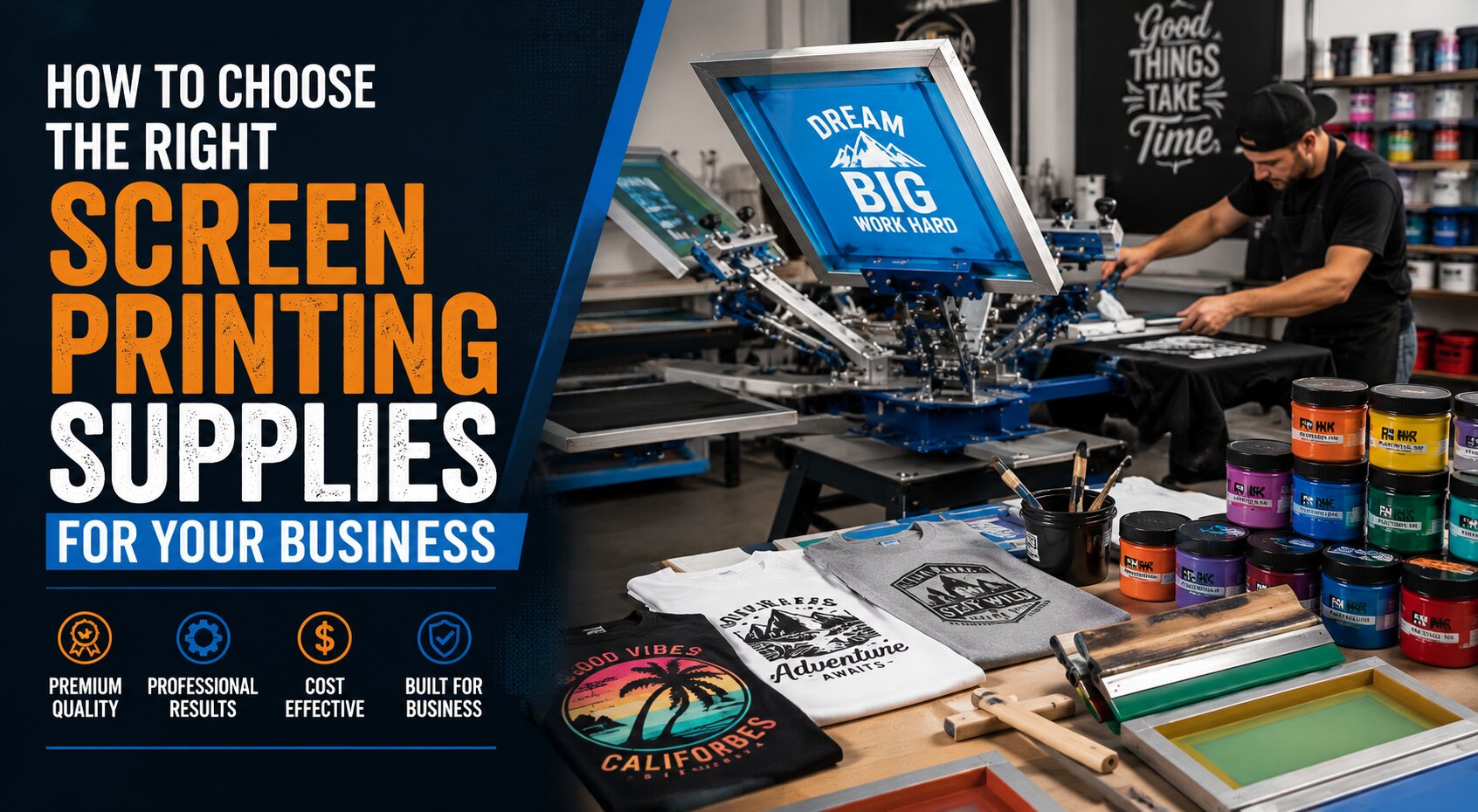
Let’s be honest — walking into the world of screen printing for the first time feels a lot like being handed a menu in a language you don’t speak. There’s mesh counts, emulsion types, plastisol versus water-based inks, flash dryers, exposure units… and everyone online seems to have a strong opinion about what you absolutely need versus what’s a complete waste of money.
Here’s the thing though: there’s no single “right” answer that works for every business. A shop cranking out 500 shirts a day has completely different needs than someone just launching their first custom apparel brand out of a garage. What matters is knowing what questions to ask — and then matching your screen printing supplies to where your business actually is right now, not where you hope it’ll be in three years.
This guide is written for real people running real businesses. Whether you’re just getting started or you’ve been printing for a while and feel like your setup isn’t quite working, here’s a practical breakdown of how to make smarter supply decisions.
First, Get Clear on What You’re Actually Printing
Before you spend a single dollar, sit down and think through your production reality. Not the dream version — the actual version.
How many shirts are you printing a week? Ten? A hundred? Five hundred? What are your customers asking for — bold one-color logos, detailed four-color artwork, or soft vintage-feel prints? Are you printing mostly cotton tees, or do you work with a mix of fabrics including polyester blends?
These questions aren’t just background noise. They directly determine which screen printing materials make sense for your shop. Someone doing short-run specialty printing for local bands doesn’t need the same ink system as someone fulfilling bulk corporate uniform orders. Getting this wrong early is how people end up with a $3,000 piece of equipment gathering dust in the corner.
The Screen Printing Press: Manual First, Upgrade Later
A lot of newcomers feel pressure to jump straight to an automatic press because it sounds more professional. Resist that urge, at least initially. Unless you’re already walking in with guaranteed high-volume contracts, a good manual press — typically a 4-color, 4-station setup — gives you everything you need to learn the craft and start generating revenue.
Manual presses are forgiving. They let you slow down, understand registration, and really feel the process. And when you do eventually outgrow one, you’ll have a much clearer idea of what you need from an automatic machine.
What to look for in a manual press: all-metal construction (no plastic joints that wobble under pressure), smooth micro-registration knobs, and a brand that’s been around long enough that spare parts are actually available. Don’t buy orphaned equipment from a company that went out of business two years ago.
Screens: The Part People Cheap Out On (Don’t)
Screens are one of those things where spending a little more upfront saves a lot of headaches later. Aluminum frames hold tension better than wood over time — wood can warp, absorb moisture, and cause your emulsion to fail in ways that are genuinely maddening to diagnose.
Mesh count is the spec that trips up most beginners. Here’s a simple way to think about it:
- Lower mesh (around 110): Thick, textured inks — glitter, puff, heavy discharge
- Mid-range mesh (160–200): Where most standard t-shirt printing lives. Good all-around choice for plastisol on cotton
- Higher mesh (230 and above): Fine detail work, halftones, four-color process printing
If you’re just starting out and printing mostly logos and text, stock up on 160 and 200 mesh screens. You can branch out once you know your most common print types.
Ink: More Options Than You Need, One Clear Starting Point
Walk into any screen printing supply store and the ink section alone can make your head spin. Water-based, plastisol, discharge, high-opacity, stretch, metallic — it genuinely never ends.
For most new and small t-shirt printing businesses, the answer is simple: start with plastisol.
Plastisol doesn’t dry in the screen while you’re working, which means you’re not racing against the clock between prints. It sits on top of the fabric rather than soaking in, giving you bright, vivid colors that hold up through washing. And it works on a huge range of garment types without major adjustments.
Water-based inks have their place — they feel softer on the shirt and have less environmental impact — but they require more experience to manage well. If you’re still learning to troubleshoot screen tension and exposure times, adding ink management complexity isn’t helping you.
Once you’re comfortable and have a specific customer niche asking for softer-hand or specialty finishes, that’s when exploring water-based or discharge inks starts making sense.
Emulsion and Exposure: Where Print Quality Actually Happens
Here’s something that doesn’t get said enough: most print quality problems don’t start at the press. They start at the exposure stage. If your emulsion is underexposed, you’ll get pinholes and blowouts mid-run. If it’s overexposed, you lose fine detail. Getting this part right makes everything downstream easier.
For beginners, a dual-cure emulsion is the most forgiving choice. It works with both plastisol and water-based inks and gives you a reasonable exposure window without punishing small timing mistakes.
On the exposure unit side — if you’re still using a DIY light box with halogen bulbs, upgrading to a proper LED unit will change your life. Consistent, even UV output means consistent screens. It’s one of those purchases that pays for itself almost immediately in reduced screen remakes.
Curing: The Step You Cannot Skip
Cured ink is everything. A print that looks perfect coming off the press but washes out after two cycles is a customer service nightmare and a reputation killer.
Flash dryers are the entry-level curing option and they work well for smaller shops doing manual printing. They’re affordable, portable, and give you enough heat to cure shirts one at a time or gel ink between colors.
As volume grows, a conveyor dryer becomes essential. You set the belt speed and temperature, shirts go in one end and come out the other fully cured. Faster, more consistent, and far less dependent on operator attention.
Whichever you use, invest in a laser temperature gun. Trust measurements, not guesswork. Plastisol cures at around 320°F — verify that’s what your garments are actually hitting.
The Small Stuff That Causes Big Headaches
Every experienced printer has a story about the day they ran out of squeegees mid-job, or forgot to order more emulsion remover, or couldn’t find the spray adhesive and watched shirts shifting on the pallet all afternoon.
Keep these stocked at all times:
- Multiple squeegee sizes and durometers (a 70-durometer is a good all-rounder)
- Spray adhesive for pallet tacking
- Emulsion remover and screen degreaser
- Packing tape for quick pinhole fixes
- Palette knives and ink spatulas
- Lint rollers for garment prep
- Nitrile gloves — seriously, buy them in bulk
These aren’t glamorous purchases. Nobody gets excited about lint rollers. But running a tight, organized shop means having what you need before you need it.
Buying From the Right Suppliers
Not all screen printing suppliers are equal. Beyond price, look for vendors who publish detailed product specs, respond quickly to pre-sale questions, and carry consistent stock. Running out of a critical ink color because your supplier has “intermittent availability” is a problem that compounds fast.
Well-regarded names in the industry include Ryonet, Lawson Screen & Digital, Saati, and Union Ink — but it’s worth testing products from a few sources before committing to one supplier for everything. Sample kits exist for a reason.
Conclusion
Choosing the right screen printing supplies doesn’t require a business degree or a massive startup budget. It requires honesty about where your business is today, a willingness to start simpler than feels impressive, and the patience to upgrade as your needs actually evolve.
Get the fundamentals right — a solid press, quality screens matched to your print types, reliable plastisol inks, good emulsion and exposure, and proper curing equipment. Master those before chasing specialty finishes or high-volume automation. That’s how print shops that last are built: one smart decision at a time.