
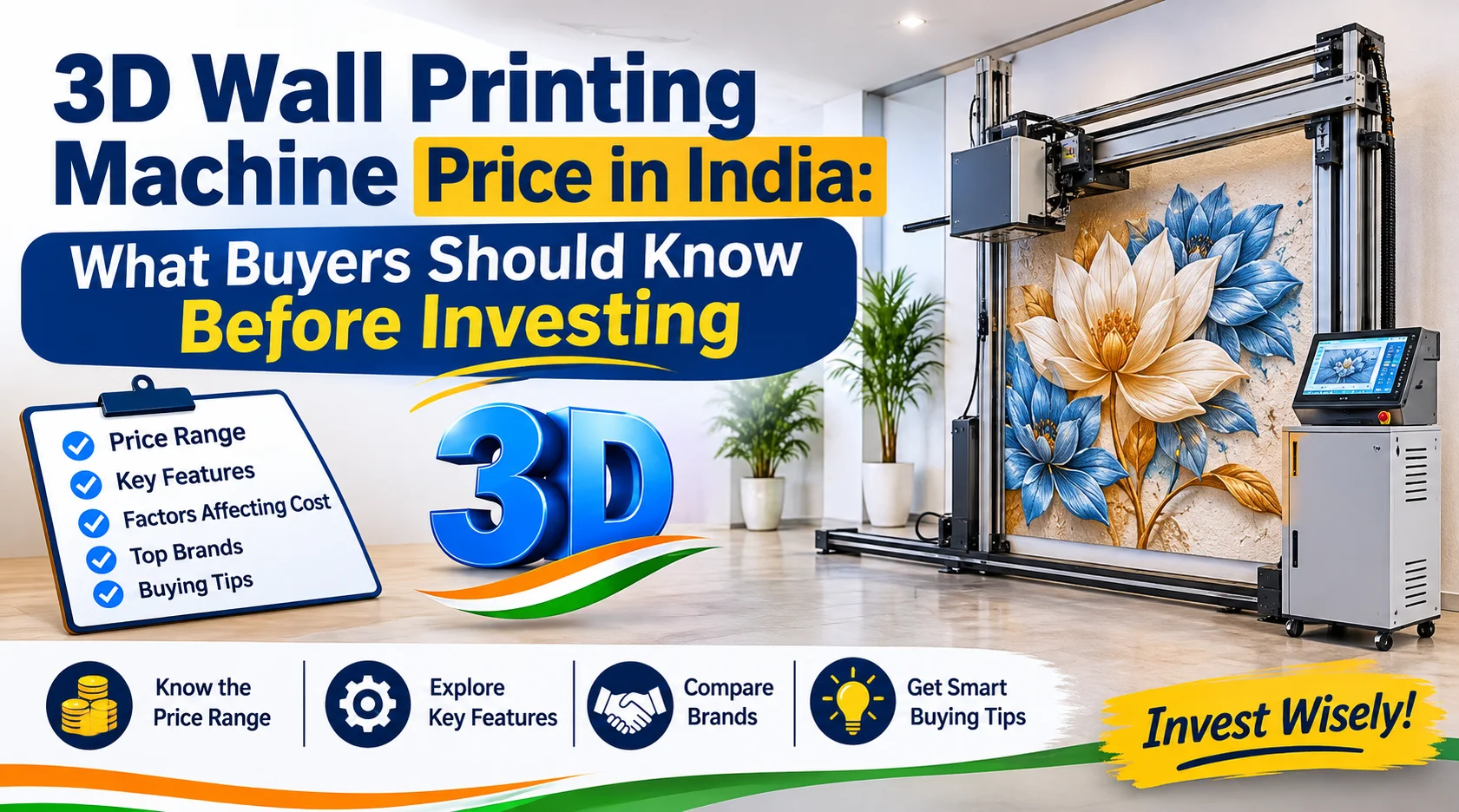
Imagine a robot arm laying down concrete layer by layer and finishing the walls of a small house in days instead of weeks. That is no longer science fiction in India. If you are a builder, contractor, startup founder or investor, your first question is probably a practical one: what is the 3D wall printing machine price in India, and is it worth the money?
This guide breaks down real price ranges, the factors that move the cost, and how to decide if the technology fits your business.
What Is a 3D Wall Printing Machine?
A 3D wall printing machine, also called a 3D concrete printer or construction 3D printer, builds walls by extruding a special cement-based mix through a nozzle, layer on layer, following a digital design. The result is a wall built with far less formwork and masonry labour.
The term “wall printing machine” can also mean something different, so be careful when you compare quotes:
- Construction 3D printers: Machines that print structural walls, boundary walls, and building components from concrete or geopolymer mixes.
- Direct-to-wall inkjet printers: Machines that print designs, murals and textures on finished walls. These are decorative tools, not building tools.
Mixing these two up is the most common mistake buyers make when searching for the 3D wall printing machine price in India.
3D Wall Printing Machine Price in India: Typical Ranges
Prices vary widely because most construction 3D printers are made to order. Based on current Indian supplier listings, here is a rough picture:
- Entry-level or educational concrete printers: Listings show lab-scale and educational models starting around ₹35 lakh, with R&D printers at roughly ₹35–45 lakh.
- Mid-range building printers: One Indian supplier lists a concrete building printer at about ₹75 lakh.
- Full-scale construction printers: Several listings place larger construction 3D printers at around ₹1 crore per unit.
- Decorative direct-to-wall inkjet machines: These are far cheaper, with listings from about ₹6.9 lakh to ₹22 lakh depending on print size and features.
Treat these as indicative figures, not fixed price tags. Online listings often show “starting from” prices, and a final quote depends on your specifications, taxes, delivery and training.
Key Factors That Affect the Price
1. Print Size and Build Volume
A bigger gantry or a longer robotic arm means more steel, more motors and more engineering. A machine that prints a compound wall is much cheaper than one that prints a double-storey structure on site.
2. Type of Printer
Gantry printers are common for on-site work, while robotic arm printers suit precast elements and complex shapes. Fully on-site systems that handle transport and setup easily usually cost more.
3. Automation Level
Semi-automatic machines need operators to guide the process. Fully automated systems with sensors, software and mixing pumps raise the price but cut labour.
4. Material Compatibility
This matters more than most buyers realise. Industry analysis warns that a printer locked into one proprietary mix can become a long-term cost trap, so ask whether the machine works with locally available cement, fly ash and sand mixes.
5. Software, Training and After-Sales Support
Slicing software, calibration, spare parts and technician training can add a meaningful amount to your budget. A cheaper machine with poor service support often costs more over time.
Is a 3D Wall Printing Machine Worth It in India?
The honest answer: it depends on volume.
Printing mainly removes masonry labour and wall formwork, so the savings apply to the walling portion of a project, not the whole building. For a single home, conventional construction usually stays cheaper, and the technology becomes compelling when the machine’s cost is spread over many units.
On the positive side, India already has working examples. The Kelvin 6K Pro, described as India’s first on-site 3D construction printer, is said to build a 2,500 sq ft home in under 30 days using a fly ash-based geopolymer. That shows real promise for affordable housing, boundary walls, public toilets, benches and compound walls.
It is also fair to note that the cost of 3D printed construction has been reported as higher than conventional building while the technology is still in its R&D phase and materials are produced in small batches. Prices should become friendlier as local manufacturing grows.
Who Should Consider Buying One?
A 3D wall printing machine makes the most sense for:
- Real estate developers planning repeated, similar units
- Precast and prefab manufacturers
- Government contractors working on affordable housing or public infrastructure
- Startups offering 3D printed construction as a service
- Engineering colleges and research labs
If you only need occasional printed walls, hiring a service provider may be smarter than buying a machine.
Smart Buying Tips
- Ask for a live demo. Watch the machine print a real wall section, not just a video.
- Compare total cost of ownership. Include mixing equipment, pumps, power backup, maintenance and operator training.
- Check material flexibility. Local, low-cost mixes protect your margins.
- Confirm reinforcement methods. Laying horizontal rebar inside an extruded wall is hard, so ask how the supplier handles structural strength.
- Verify compliance and certification. Ask about structural testing and local building approvals.
- Get at least three written quotes. Specifications differ, so compare line by line.
Business owners researching equipment investments can also find broader market insights and industry coverage on Top Business Magazine.
The Future of 3D Wall Printing in India
Demand for fast, affordable and low-waste housing is pushing this technology forward. Government interest in affordable housing, startup innovation and growing awareness among builders point to steady adoption. As more machines are made locally, buyers can expect better service networks and, over time, more competitive pricing.
Conclusion
The 3D wall printing machine price in India ranges from a few lakh rupees for decorative inkjet wall printers to nearly a crore for full-scale construction printers. The right choice depends on what you want to build, how often you will use the machine, and how well it works with local materials. Do your homework, compare quotes, ask for demonstrations, and calculate your return over multiple projects, not just one. Buy smart, and a 3D wall printer can become a genuine competitive edge.
Frequently Asked Questions
Q.1 What is the average 3D wall printing machine price in India?
It depends on the machine type. Decorative direct-to-wall printers start at a few lakh rupees, while construction-grade concrete 3D printers typically range from about ₹35 lakh to ₹1 crore or more, depending on size and automation.
Q.2 Is a 3D wall printing machine cheaper than traditional construction?
Not always. It saves on masonry labour and formwork, but the machine’s upfront cost is high. It pays off mainly when used across many repeated units.
Q.3 Can a 3D concrete printer print a complete house?
Yes, on-site printers can print the walls of a house, and Indian projects have demonstrated this. Roofs, doors, windows, and finishing usually still use conventional methods.
Q.4 What materials do 3D wall printing machines use?
Most use specially designed cement mortar or geopolymer mixes, sometimes with fly ash. Always check that your machine accepts locally available materials.
Q.5 Should I buy a machine or hire a 3D printing construction service?
If your project volume is low, hiring a service provider is usually more economical. Buying makes sense when you have a steady pipeline of projects.