For a couple of years, “quiet quitting” was everywhere. It dominated LinkedIn think-pieces, HR conferences, and management blogs. The narrative was neat: a burned-out generation had stopped caring, was doing the bare minimum, and was waiting to leave. Managers panicked. Productivity consultants cashed in. Headlines multiplied.
Here’s the update: that narrative was never entirely accurate, and in 2026 it’s clearly outdated. Gen Z work trends 2026 have shifted, matured, and in some ways surprised everyone — including the researchers who spent the last three years studying this generation’s relationship with work.
What’s actually happening is more interesting, more nuanced, and more important for employers to understand than any single trend label. Gen Z workers in the US, Canada, UK, and Australia are not disengaged. They are selective. And that distinction changes everything about how the best companies are responding.
What Quiet Quitting Was Really About
Before declaring quiet quitting dead, it’s worth being honest about what it represented. When the phrase went viral in mid-2022, it captured something real: a generation entering the workforce during a pandemic, watching companies conduct mass layoffs over Zoom while simultaneously demanding increased productivity, and deciding — rationally — not to give more than was required.
Quiet quitting was not laziness. It was a boundary-setting response to workplace conditions that felt exploitative. Gen Z, more than any previous generation, arrived in the workforce with a clear-eyed view of what companies would and wouldn’t do for their employees. They’d watched their parents get restructured out of companies they’d given decades to. They weren’t going to repeat that.
The misread: Most management commentary treated quiet quitting as an attitude problem to be fixed. What it actually was: a data point telling employers exactly what wasn’t working about their culture, compensation, and value exchange.
In 2026, the workers who were “quiet quitting” three years ago have either left those jobs, found employers who worked better for them, or — in significant numbers — built their own income outside the traditional employment structure entirely. Quiet quitting as a sustained strategy has largely run its course.
From Quiet Quitting to Selective Ambition: Then vs Now
Gen Z’s relationship with work hasn’t become more passive — it’s become more strategic. Here’s how the shift looks in practice:
| What Gen Z Did (2022–2023) | What Gen Z Wants (2025–2026) |
|---|---|
| Quiet quitting — doing the bare minimum | Selective ambition — going all-in on meaningful work |
| Posting “anti-work” content online | Building personal brands and side businesses |
| Rejecting hustle culture entirely | Redefining what hustle looks like on their terms |
| Treating loyalty as a liability | Seeking employers who earn loyalty through action |
| Avoiding long-term career commitments | Planning strategically but staying mobile |
| Protesting poor workplace culture vocally | Voting with their feet — quietly moving on |
What Gen Z Actually Wants From Employers in 2026
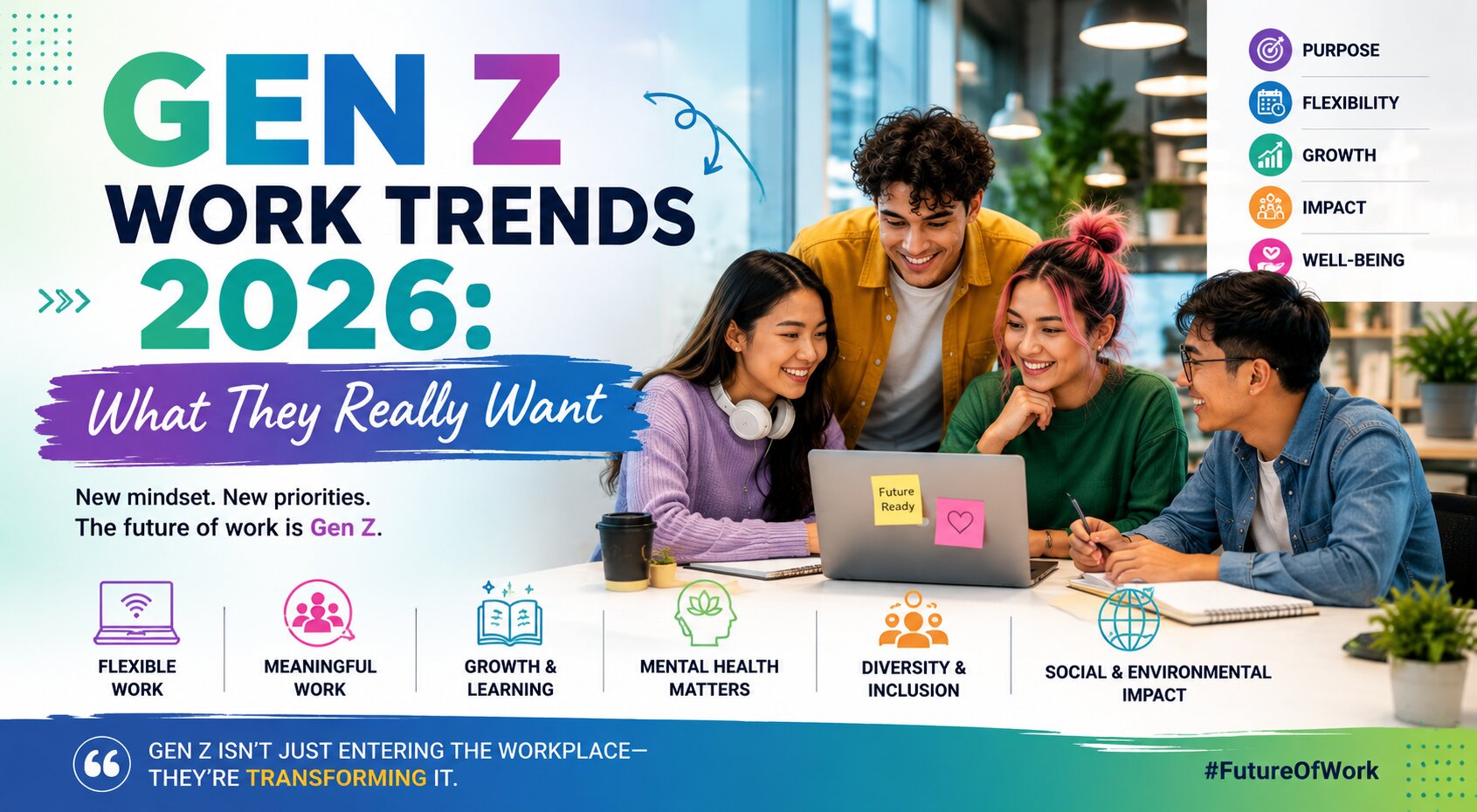
Understanding Gen Z work trends 2026 requires ditching the assumption that this generation doesn’t want to work hard. The data consistently shows the opposite: Gen Z is ambitious — sometimes intensely so — but their ambition is conditional. They want to work hard for something that feels worth working hard for.
1. Genuine Flexibility — Not a Policy, a Practice
Remote and hybrid work arrangements are no longer a perk that impresses Gen Z — they’re a baseline expectation. But what Gen Z career expectations reveal in 2026 is more specific than just “work from home”: they want genuine autonomy over how, when, and where they work, not a structured “flex” arrangement that requires them to justify working from a coffee shop on a Tuesday.
Survey data from multiple HR research firms in 2025 consistently shows that schedule flexibility now ranks above salary in job acceptance decisions for workers under 30 — for the first time in modern employment research history.
Companies that have built genuinely flexible cultures — not performative ones — are consistently outperforming their peers in Gen Z recruitment and retention. Those that have mandated rigid return-to-office policies without clear justification have seen the highest attrition in this age group.
2. A Manager They Can Actually Respect
One of the most consistent findings in research on Gen Z and work is the outsized importance of direct management quality. More than company values, benefits packages, or office perks, Gen Z workers cite their relationship with their immediate manager as the primary driver of both engagement and resignation decisions.
What they’re looking for in a manager isn’t a mentor in the traditional sense — it’s someone who is transparent, gives real feedback (not performative praise), advocates for their team, and doesn’t manage through fear or micromanagement. In 2026, “my manager is terrible” remains the single most common reason Gen Z workers give when leaving a role within the first 18 months.
Employer takeaway: Investing in middle management development isn’t a soft-skills initiative — it’s your most direct lever for reducing Gen Z attrition.
3. Clear Growth — Or an Honest Conversation About Why There Isn’t Any
Gen Z career expectations around progression are often mischaracterised as impatience. The reality is more specific: they want to know, concretely, what growth looks like in their role and on what timeline. Vague promises about “opportunities” irritate them. Clear, honest conversations — including honest discussions about the ceiling of a role — earn significant trust.
Companies that have introduced transparent career laddering — publishing explicit criteria for promotion decisions — report meaningfully higher satisfaction scores among workers under 30. The willingness to be honest, even when the honest answer is “this role doesn’t grow into a senior track,” is valued more than false optimism.
4. Compensation That Keeps Up With Reality
Salary transparency has become both a legal requirement in several US states and Canadian provinces, and a cultural expectation across the UK and Australia. Gen Z workers in 2026 arrive at salary conversations already knowing what the market pays for their skills, what their colleagues earn (often discussed openly, which older generations find jarring but Gen Z considers normal), and what the cost of living in their city actually requires.
“Competitive compensation” is a phrase that has lost all meaning to this cohort. They want numbers, justifications, and timelines for increases. Companies that provide these — clearly and proactively — build the kind of trust that makes Gen Z workers stay.
Research by multiple compensation analytics firms shows that pay transparency increases Gen Z job offer acceptance rates by 40–60% compared to roles that withhold salary information from job postings.
5. Work That Connects to Something Larger
This is the element most cynically dismissed by older managers — and the one most backed by behavioural data. Gen Z workers consistently report that a sense of purpose or social meaning in their work matters to their engagement. This doesn’t mean every company needs to be a charity. It means that Gen Z wants to understand what their work is actually for: what problem it solves, who it serves, and why it matters beyond the bottom line.
Companies that communicate this clearly — at the team level, not just in a mission statement on a wall — see measurably higher discretionary effort from their youngest employees. It’s not idealism for its own sake. It’s the difference between employees who clock in and employees who care.
The Bigger Shift: Gen Z Is Building Alongside Their Jobs
Perhaps the most significant Gen Z work trends 2026 is one that employers still underestimate: a large and growing proportion of Gen Z workers do not view their primary job as their only income source, their main career, or even their primary professional identity.
Side businesses, freelance income, content creation, digital product sales, and investment portfolios are being built in parallel with full-time employment — often deliberately, and with a specific exit timeline in mind. This isn’t a threat to employers (the majority of Gen Z still prioritise stable employment), but it is context that explains some of what looks like disengagement. The worker who seems “checked out” may simply be focused elsewhere, and no amount of engagement initiatives will change that if the job isn’t competitive in what it actually offers.
The companies winning Gen Z loyalty in 2026 are not those offering ping-pong tables or meditation apps. They are offering autonomy, genuine respect, honest communication, fair pay, and the sense that working there is actually worth someone’s limited time.
What Employers Should Do Differently in 2026
For HR leaders, managers, and business owners trying to navigate Gen Z work trends in 2026, here’s a practical summary of what the evidence suggests:
- Audit your flexibility: Is remote or hybrid work genuinely flexible, or is it a limited version of flexibility that still centres the office? Gen Z notices the difference.
- Invest in manager quality: Train, support, and hold managers accountable for how they treat their teams. This single variable explains more attrition than any other.
- Be radically transparent about compensation and career growth: Vagueness is interpreted as either incompetence or dishonesty. Neither builds loyalty.
- Stop competing on perks: Benefits matter, but they are not what drives Gen Z’s decision to stay or go. Culture and management quality are.
- Ask — and listen: Gen Z are vocal about what they need, but only to employers who create the conditions for honest feedback. Anonymous pulse surveys and genuine follow-through on what they surface are worth far more than annual engagement scores.
Final Thoughts
Gen Z work trends in 2026 tell a story of a generation that has moved past protest and into pragmatism. Quiet quitting was a moment — a signal that something was broken in the employer-employee relationship. The generation that sent that signal hasn’t gone quiet. They’ve simply gotten smarter about where they invest their energy.
The companies that will attract and keep the best young talent over the next decade are not necessarily the biggest, the most prestigious, or the highest payers. They’re the ones that treat people like adults, communicate honestly, build cultures of genuine respect, and understand that earning loyalty in 2026 requires actually being worth someone’s commitment. That’s not a Gen Z problem. That’s just good management — and it’s long overdue.
Frequently Asked Questions (FAQs)
Q1. Is quiet quitting still happening in 2026?
Quiet quitting as a widespread, talked-about trend has largely faded from 2026 workplace conversations. The underlying conditions that produced it — burnout, distrust of employers, poor work-life balance — haven’t disappeared, but Gen Z has largely moved from passive disengagement toward more active responses: finding better employers, building income outside their primary job, or negotiating more directly for what they need. The behaviour exists, but the cultural moment has passed.
Q2. What do Gen Z workers value most in a job in 2026?
According to multiple workforce surveys conducted in 2024 and 2025, Gen Z workers in the US, Canada, UK, and Australia consistently rank genuine schedule flexibility, quality of direct management, salary transparency, and clear career progression paths as their top four job priorities. Perks like gym memberships and office amenities rank consistently low compared to these structural factors.
Q3. How is Gen Z different from Millennials in the workplace?
While both generations value flexibility and meaningful work, Gen Z entered the workforce during unprecedented disruption — the COVID-19 pandemic, remote work normalisation, and rapid AI adoption — and their workplace expectations reflect this. They are more likely than Millennials to discuss pay openly with colleagues, more likely to have income sources outside their primary employer, and less likely to attach their professional identity to their job title. They also have a higher tolerance for job mobility and a lower tolerance for management by hierarchy or intimidation.
Q4. What are the biggest workplace trends in 2026?
The most significant workplace trends 2026 include: the continued normalisation of AI-assisted work and the skills gap this is creating; the rise of skills-based hiring over credential-based hiring; increasing salary transparency driven by legislation and cultural shift; the growth of portfolio careers (multiple income streams alongside primary employment); and the ongoing tension between employer return-to-office mandates and employee expectations of hybrid flexibility. Gen Z sits at the centre of almost all of these trends.
Q5. How can employers improve Gen Z retention in 2026?
The highest-impact strategies for improving Gen Z retention in 2026 are: investing in middle management training and accountability; publishing clear, criteria-based career ladders; offering genuine (not performative) schedule flexibility; conducting and acting on regular anonymous feedback; and being transparent about compensation — both in job postings and in internal conversations. Companies that address these structural factors consistently outperform those focused primarily on perks and culture initiatives.