


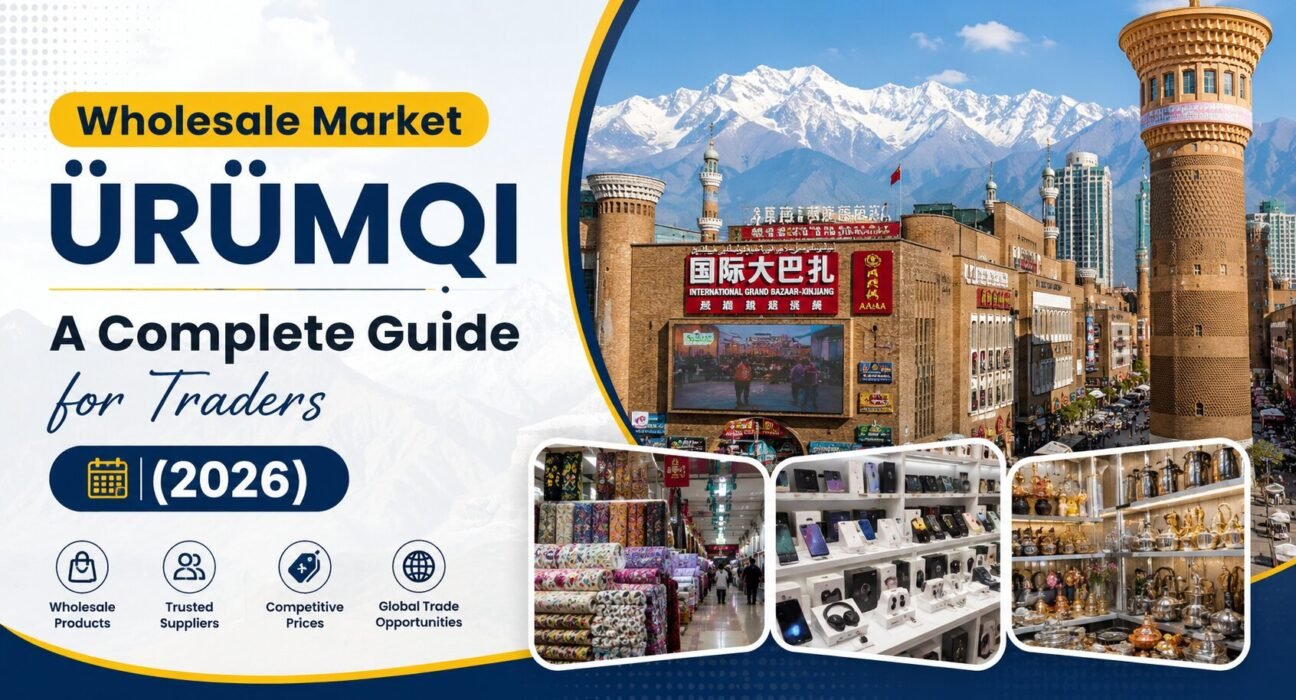
Ürümqi doesn’t get the sourcing-hub attention that Yiwu or Guangzhou get in most wholesale trade guides, and that’s largely a geography problem for content writers, not a reflection of its actual importance. As the capital of Xinjiang and China’s primary gateway to Central Asia, Ürümqi sits at the center of a trade corridor that’s been growing faster than China’s national average — and it’s home to one of the country’s most distinctive wholesale markets, built around goods you genuinely won’t find concentrated the same way anywhere else in China.
Quick answer: Ürümqi’s wholesale trade centers on a handful of major markets — Erdaoqiao Market (the largest, best known for dried fruits, handicrafts, carpets, and ethnic minority goods), the Hualing Wholesale Market (textiles, electronics, household goods), and the nearby Hetian Jade Trading Center for jade specifically. The city functions as Xinjiang’s core trade gateway under China’s Belt and Road Initiative, with the region’s foreign trade reaching 71.22 billion yuan (roughly $10.3 billion) in just the first two months of 2026 — up 36% year-on-year, driven heavily by trade with Central Asia, ASEAN, and Russia.
Why Ürümqi Matters for Wholesale Trade
It’s a really rare location for Ürümqi on a Chinese trade map. It has become a hub for overland trade between China and Central Asian nations as it has become the closer the natural hub to Central Asian capitals, such as Kazakhstan, Kyrgyzstan and beyond. This is happening on a massive scale as revealed by official 2026 trade statistics from Ürümqi Customs, where more than 90 percent of Xinjiang’s trade is with BRI countries and more than 180 percent of its trade with ASEAN alone is up compared to 2025.
This matters for anyone sourcing goods, because it means Ürümqi’s wholesale markets serve two distinct functions: a genuine retail and regional wholesale hub for Xinjiang’s own distinctive products (dried fruits, jade, ethnic handicrafts), and an increasingly important logistics and trade gateway for goods moving between China and Central Asia more broadly.
Erdaoqiao Market: Xinjiang’s Largest Wholesale and Retail Market
The market most synonymous with Ürümqi is the Erdaoqiao Market, which is not only the biggest retail and wholesale market for ethnic minority products in all of Xinjiang, but has been a trading post for over 130 years, linking Ürümqi with Central Asia.
Key details:
- A six-story building complex spanning roughly 8,818 square meters, with an adjoining older covered market section built in 1982.
- More than 660 stalls selling over 1,600 kinds of Uyghur goods, drawing more than 20,000 vendors, merchants, and visitors daily.
- The first three floors serve as the main commercial area — largely dried fruits, handicrafts, textiles, and traditional goods.
- Sits directly adjacent to the Urumqi International Bazaar and the Hetian Jade Trading Center, forming a connected trading district rather than a single isolated building.
- A “New Erdaoqiao Market” extension was added in 2001, expanding the complex further.
For buyers, Erdaoqiao is best understood less as a single wholesale warehouse and more as a dense, historic trading district — closer in spirit to a large traditional bazaar than a modern industrial wholesale park, even though genuine bulk wholesale transactions happen there regularly.
Hualing Wholesale Market: Textiles, Electronics, and Household Goods
The Urumqi Hualing Wholesale Market is the city’s other major wholesale hub, and it serves a notably different purpose than Erdaoqiao — it’s known specifically for textiles, electronics, and household goods, positioning it closer to a conventional Chinese wholesale market than Erdaoqiao’s more culturally distinctive, tourism-adjacent character. This is generally the better starting point for buyers looking for standard manufactured goods rather than regional specialty products.
What to Actually Source From Ürümqi
| Category | Where to Look | Notes |
|---|---|---|
| Dried fruits and nuts | Erdaoqiao Market | Xinjiang is well known within China for high-quality dried fruit production |
| Handicrafts and carpets | Erdaoqiao Market | Traditional Uyghur craftsmanship, often region-specific |
| Jade | Hetian Jade Trading Center | Hetian (Khotan) jade is a specifically prized regional specialty |
| Textiles | Hualing Wholesale Market | More conventional bulk textile sourcing |
| Electronics and household goods | Hualing Wholesale Market | General consumer goods, less regionally distinctive |
| Herbs and specialty agricultural products | Supplier platforms (Alibaba, Made-in-China) | Xinjiang-based suppliers list items like cordyceps and other regional herbs |
Ürümqi’s Trade Infrastructure and Growth
A few structural factors are worth understanding if you’re considering Ürümqi as a sourcing destination rather than just a market to browse:
- Belt and Road positioning: Xinjiang operates as a designated core area of China’s Belt and Road Initiative, and the region’s trade data reflects that directly — the vast majority of its foreign trade now flows through BRI partner countries.
- Rapid recent growth: foreign trade value in the region grew 36% year-on-year in early 2026, notably outpacing China’s national trade growth average, with private businesses accounting for the large majority of that trade volume.
- The Urumqi Foreign Economic Relations and Trade Fair (“Urumqi Fair”): an annual trade fair held since 1992, widely regarded as the largest trade fair in Western China, specifically focused on connecting Xinjiang and Central Asian trade. It has run in a hybrid online-offline format since 2020, including blockchain-based contract signing for participants unable to attend in person.
- Shifting export mix: mechanical and electrical products have overtaken traditional categories as Xinjiang’s top exports, alongside continued strength in agricultural imports — a signal that the region’s trade profile is diversifying beyond its traditional reputation for raw and agricultural goods.
How to Actually Source From Ürümqi as a Buyer
- Decide whether you need physical market access or supplier-platform sourcing. Erdaoqiao is genuinely worth an in-person visit for handicrafts, dried fruits, and jade, where quality and authenticity are easier to judge in person. For textiles, electronics, and manufactured goods, established platforms (Alibaba, Made-in-China) listing Ürümqi-based suppliers may be more efficient than a physical visit.
- Consider timing a trip around the Urumqi Fair if you’re pursuing broader Central Asia-facing trade relationships, since it concentrates a large number of regional trade contacts in one event.
- Work with a local sourcing agent or trading company for first-time buyers, particularly for larger orders — this reduces the language barrier (Mandarin and Uyghur are both widely used) and helps verify supplier legitimacy before committing to bulk purchases.
- Verify suppliers independently, especially when sourcing through online platforms rather than an in-person market visit — standard due diligence (checking business licenses, requesting samples, starting with smaller trial orders) applies here as it would with any overseas sourcing relationship.
- Factor in logistics from Xinjiang specifically. Given the region’s interior location, shipping timelines and routes from Ürümqi can differ meaningfully from coastal Chinese manufacturing hubs — confirm logistics options early rather than assuming standard coastal shipping timelines apply.
Who This Is Actually Useful For
- Importers and wholesalers interested in Xinjiang-specific specialty goods — dried fruits, jade, carpets, and traditional handicrafts genuinely concentrated in this region.
- Traders exploring China-Central Asia trade routes, given Ürümqi’s structural position as the primary gateway for that corridor.
- Buyers already sourcing from China who want to diversify beyond the more commonly covered coastal manufacturing hubs.
Probably not the most efficient choice for: buyers seeking the cheapest possible standard manufactured goods available more efficiently through China’s larger coastal wholesale hubs (Yiwu, Guangzhou), where Ürümqi doesn’t hold a particular cost or specialization advantage.
Conclusion
Ürümqi’s wholesale trade scene splits cleanly into two categories worth understanding separately: Erdaoqiao Market’s historic, culturally distinctive trade in dried fruits, jade, and handicrafts, and the more conventional manufactured-goods sourcing available through the Hualing Wholesale Market and standard supplier platforms. For buyers specifically interested in Xinjiang’s regional specialties or the broader China-Central Asia trade corridor, it’s a genuinely underexplored sourcing destination — just not the right fit if you’re chasing the lowest possible cost on standard manufactured goods available more efficiently elsewhere in China.
FAQs
Q. What is the biggest wholesale market in Ürümqi?
The six-story Erdaoqiao market is the biggest retail and wholesale market in the area, and has served as a trading center between Xinjiang and Central Asia for over 130 years.
Q. What products is Ürümqi known for in wholesale trade?
Dried fruits and nuts, handicrafts, carpets, and jade (particularly from the nearby Hetian Jade Trading Center) are the region’s most distinctive specialties, while the Hualing Wholesale Market covers more conventional textiles, electronics, and household goods.
Q. Is Ürümqi a good sourcing destination for international buyers?
It’s a strong option specifically for Xinjiang’s regional specialty goods and for buyers interested in China-Central Asia trade relationships, though it’s less competitive than China’s larger coastal wholesale hubs for general low-cost manufactured goods.
Q. What is the Urumqi Fair?
It is a trade fair held in Urumqi once a year since 1992, which is considered as the biggest trade fair in Western China and mainly serves as a platform to promote trade between Xinjiang and Central Asian countries.
Q. How is Xinjiang’s trade with Central Asia growing?
Xinjiang’s overall foreign trade grew 36% year-on-year in the first two months of 2026, with the large majority of that trade flowing through Belt and Road partner countries, including strong growth specifically with Central Asian markets, ASEAN, and Russia.