

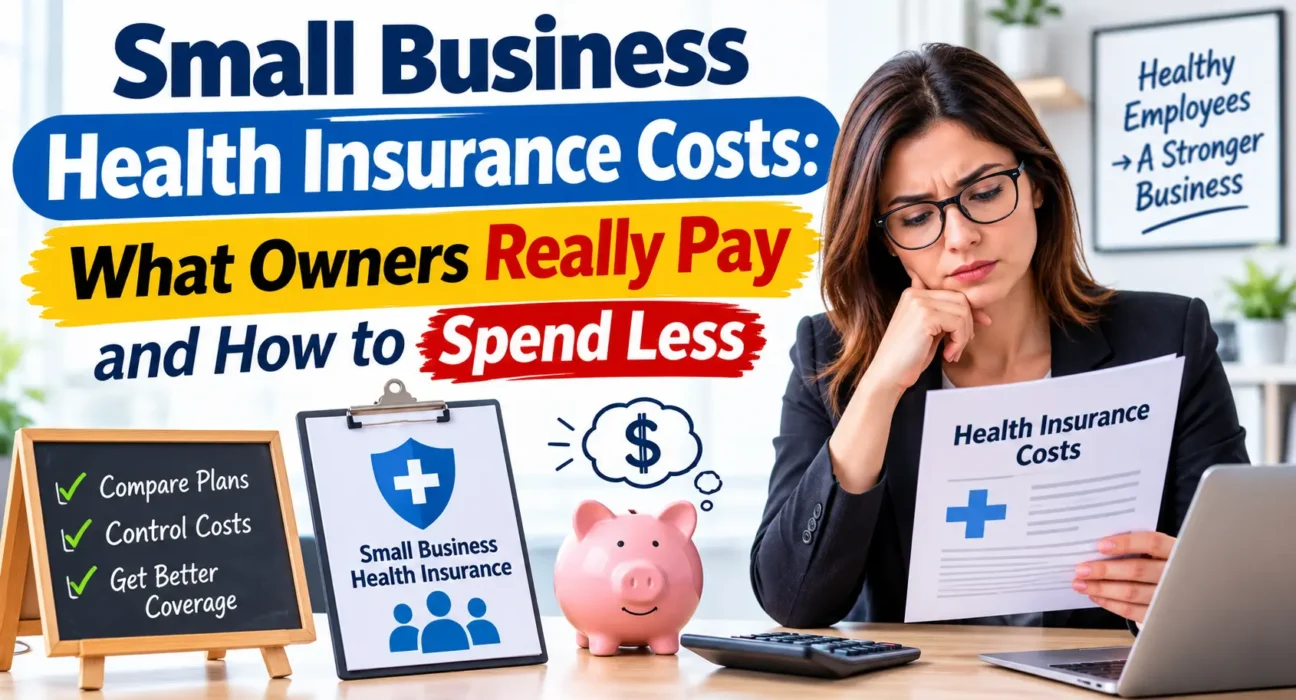
You hired your first few employees, and sales are finally steady. Then the health insurance quote lands in your inbox, and your stomach drops.
If that sounds familiar, you’re not alone. For many owners, small business health insurance costs are one of the biggest line items after payroll and rent. The good news is that you have more control than you might think. This guide breaks down what employers typically pay, what pushes premiums up, and how to keep coverage affordable without losing good people.
What Are the Average Small Business Health Insurance Costs?
Costs vary by location, age, and plan type, but national data gives a useful benchmark. According to KFF’s 2025 Employer Health Benefits Survey, average annual premiums for employer-sponsored coverage were $9,325 for single coverage and $26,993 for family coverage.
Smaller employers land in a similar range. Among firms with 10 to 199 workers, single coverage averaged $9,211 and family coverage averaged $26,054.
That works out to roughly $770 a month per person for single coverage. Of course, you rarely pay all of it.
Who Pays What?
Most employers split the premium with workers. On average, covered employees contribute 16% of the premium for single coverage and 26% for family coverage. The rest falls on the business.
Some small firms cover everything. KFF found that 29% of covered workers at firms with 10 to 199 employees have the full single premium paid by their employer. That’s a generous perk, but it also shows why budgeting matters. kff
Why Are Premiums Rising?
Health plan prices have climbed faster than most owners’ revenue. In 2025, premiums rose 5% for single coverage and 6% for family coverage, and early reports suggest cost trends could be higher for 2026.
Several factors sit behind the increase:
- Rising medical and prescription drug prices, including newer specialty medications
- Higher hospital and provider costs passed on to insurers
- Claims history and group risk, since a few high-cost claims can shake up a small group’s renewal rate
- Workforce age, because older groups generally cost more to insure
- Location, as state regulations and local provider networks change pricing
Key Factors That Shape Your Group Health Insurance Quote
Two businesses with the same headcount can receive very different quotes. Here’s what insurers look at.
Employee Demographics
Average age, the number of dependents covered, and the zip codes where your team lives all feed into the rate.
Plan Type and Metal Tier
PPOs offer flexibility but cost more. HMOs and high-deductible health plans (HDHPs) usually come with lower premiums. For example, HDHPs with a savings option averaged $8,620 for single coverage, which is below the overall average.
Deductibles and Cost Sharing
A lower premium often means a higher deductible. The average single deductible in 2025 was $1,886, but workers at small firms faced $2,631. Smaller companies often push more cost sharing onto employees, so check that your team can handle it. managedhealthcareexecutive
Funding Method
Fully insured plans are the traditional route. Some small firms are now exploring alternatives. KFF reports that 37% of covered workers in small firms participate in level-funded plans, which blend self-funding with stop-loss protection. These can lower costs for healthy groups, but they come with more risk, so talk to a licensed broker first. nisbenefits
7 Practical Ways to Lower Small Business Health Insurance Costs
You don’t have to choose between your budget and your people. Try these strategies.
- Compare multiple carriers every year. Don’t auto-renew. Rates and networks change, and a competing quote can save thousands.
- Work with an independent broker. Good brokers shop the market for you, and their help is often free to the employer.
- Consider a high-deductible plan with an HSA. Lower premiums plus tax-advantaged savings can suit younger, healthier teams.
- Look into an ICHRA. An Individual Coverage HRA lets you give employees a fixed monthly allowance toward plans they choose, which makes your budget predictable.
- Claim the Small Business Health Care Tax Credit. Eligible employers with fewer than 25 full-time-equivalent employees and below-threshold average wages may receive a credit of up to 50% of premiums paid. Rules and income limits change, so confirm current details on IRS.gov.
- Offer wellness programs. Screenings and coaching can improve long-term health. Many small firms already offer them, and more than half of small firms provide programs like smoking cessation or weight management. managedhealthcareexecutive
- Adjust your contribution strategy. You could cover employee-only premiums fully and ask workers to share dependent costs. This protects your budget while still offering real value.
Is Offering Health Insurance Worth It?
Not every small employer does. Only 59% of smaller firms offer health benefits, compared with 97% of large firms. But if you’re competing for talent, coverage can be the deciding factor between you and a bigger company. zywave
Benefits also tend to improve retention, which saves you recruiting and training costs. And employer contributions are generally tax-deductible, which softens the blow on your books.
Smart Budgeting Tips for Owners
- Set a per-employee monthly budget before you request quotes.
- Build in a 6 to 10 percent cushion for renewal increases.
- Review your plan at least 90 days before renewal.
- Ask your broker about composite rates and participation requirements.
- Keep an eye on business finance trends through resources like Top Business Magazine.
Final Thoughts
Small business health insurance costs are a real challenge, but they’re manageable with the right plan. Know your benchmarks, shop around every year, and use tools like HSAs, ICHRAs, and tax credits to stretch each dollar. Do that, and you can offer benefits that attract and keep great employees without putting your finances at risk.
Start by requesting at least three quotes this quarter. The comparison alone may surprise you
Frequently Asked Questions
Is small business health insurance tax-deductible?
In most cases, yes. Premiums an employer pays for employees are generally deductible as a business expense. Speak with a tax professional about your specific situation.
What is the cheapest health insurance option for a small business?
High-deductible health plans and HMOs typically carry the lowest premiums. Level-funded plans or an ICHRA can also lower costs, depending on your workforce.
Do I have to offer health insurance to my employees?
Under the Affordable Care Act, only applicable large employers (generally 50 or more full-time-equivalent employees) must offer coverage. Smaller businesses can choose whether to offer it.
How can I reduce my premiums at renewal?
Compare quotes from several carriers, adjust your plan design, raise deductibles carefully, and use a broker. Also check whether you qualify for the small business health care tax credit.