


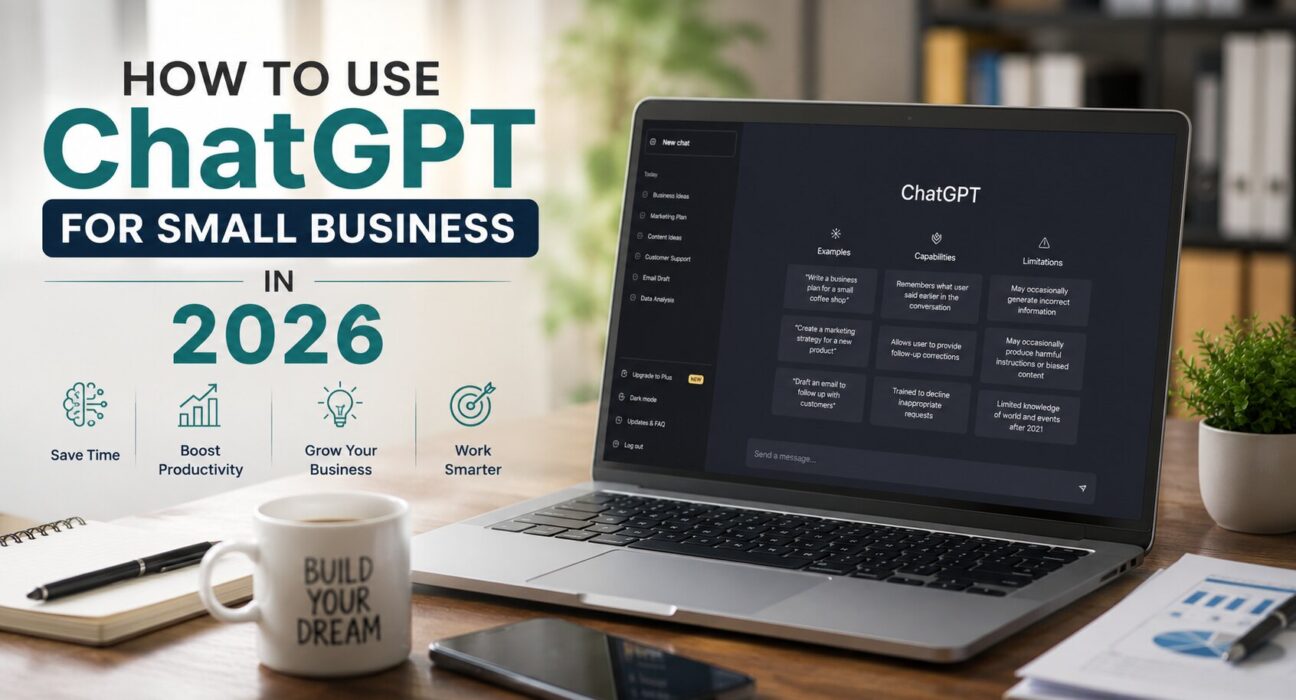
Running a small business means wearing every hat at once — marketer, customer support rep, content writer, accountant, and decision-maker, sometimes all before lunch. Most small business owners are not short on ideas; they are short on time. That is exactly where ChatGPT for small business has become a genuine game-changer.
In the past two years, entrepreneurs across India and around the world have quietly built ChatGPT into their daily workflow — using it to write product descriptions, handle customer enquiries, draft social media content, create training documents, and brainstorm new revenue ideas. The results are not theoretical. They are saving hours every single week.
This article is a practical, no-fluff guide to using ChatGPT in your small business right now — whatever your industry, budget, or technical comfort level.
What Is ChatGPT and Why Should Small Business Owners Care?
ChatGPT is an AI-powered conversational tool built by OpenAI. You type a message — a question, a task, or a prompt — and it responds with intelligent, context-aware text. It can write, explain, summarise, translate, code, and brainstorm at a level that has surprised even its own creators.
For small business owners specifically, ChatGPT acts like an on-call assistant who never sleeps, never asks for a salary, and can turn around a polished first draft in under a minute. The free version (GPT-4o on the free plan) is powerful enough for most tasks. The paid plan (ChatGPT Plus, currently around $20/month) adds faster responses, image generation, and access to custom GPTs built for specific workflows.
Quick Answer: ChatGPT for small business helps entrepreneurs save time and cut costs by automating writing, customer communication, research, and operations tasks. It works through a simple chat interface — no coding required — and is accessible on desktop and mobile. The free tier is sufficient for most small business use cases.
What Can ChatGPT Actually Do for Your Business? (At a Glance)
Before diving into the how-to, here is a practical overview of where ChatGPT delivers the most measurable value for small business owners:
| Business Task | What ChatGPT Does | Time Saved (Est.) |
|---|---|---|
| Blog writing | Drafts full posts from a headline | 2–3 hours/article |
| Customer emails | Writes professional replies in seconds | 30–60 min/day |
| Social captions | Generates a week of posts in minutes | 1–2 hours/week |
| Product descriptions | Creates SEO-friendly copy at scale | Hours per catalogue |
| Market research | Summarises trends, competitors, niches | Half a day |
| Training documents | Writes SOPs and onboarding guides | Full day++ |
Now let us break down each major use case in detail — with real prompt examples you can use today.
1. Content Marketing and Blog Writing
Content is still one of the most powerful ways to attract customers organically — but writing consistently is exhausting. ChatGPT for small business makes it manageable.
How to Use It
- Give ChatGPT a clear brief: topic, target audience, tone, and approximate word count.
- Ask it to generate an outline first. Review the structure before committing to a full draft.
- Request the full article in sections to maintain quality across longer pieces.
- Edit the output — add your specific examples, local context, and brand voice before publishing.
Example prompt: “Write a 600-word blog post for a small Indian bakery targeting Mumbai customers. Topic: 5 reasons to order a custom cake for corporate events. Tone: warm, professional. Include a call to action at the end.”
The draft you get will need editing, but it gives you a structured, readable starting point in under 30 seconds instead of staring at a blank page for 45 minutes.
2. Customer Communication and Email Writing
Writing professional, empathetic customer emails takes time — especially when you are handling complaints, refund requests, or complex order queries. AI for entrepreneurs has made this one of the highest-ROI use cases available.
Use Cases in this category include:
- Addressing Customer Complaints in an Empathetic and resolution-oriented manner.
- Follow-up emails following a sale/service delivery
- Creating newsletter copy for subscribers list
- Designing order confirmation, shipping notification and refund emails templates.
- Customer emails can be translated into Tamil, Hindi, Bengali, etc., languages for businesses in India.
Example prompt: “A customer emailed saying their order arrived damaged. Write a professional, apologetic reply that offers a replacement or refund, and reassures them this is not typical. Keep it under 150 words.”
You get a polished, human-sounding response in seconds. Personalise it with the customer’s name and specific details, and you are done.
3. Social Media Content Creation
Consistency on social media is what builds audiences — but coming up with fresh ideas and writing captions daily drains creative energy fast. This is one of the most popular ways small businesses use ChatGPT.
What You Can Generate
- A week’s worth of Instagram captions from a single product description
- LinkedIn posts establishing your expertise in your industry
- Short-form video scripts for Instagram Reels or YouTube Shorts
- Hashtag sets optimised for your niche and region
- Poll questions, story prompts, and engagement posts
“Create five engaging Instagram captions for a Bangalore-based home cleaning service. Keep each caption under 100 words, use a friendly and approachable tone, include a clear call to action, and finish with five relevant hashtags.”
For a broader look at digital tools that support your content strategy, read our guide on the best free AI writing tools for content creators in 2026 — several of them pair well with ChatGPT for a complete workflow.
4. How to Automate Business With AI Using ChatGPT
Beyond writing, ChatGPT can help you automate business with AI in operational areas that most small business owners overlook.
Operations and Internal Workflows
- Standard Operating Procedures (SOPs): describe a process verbally and ask ChatGPT to convert it into a step-by-step SOP document for your team.
- Job descriptions: write a clear brief for a role and let ChatGPT produce a professional job posting in minutes.
- Meeting agendas: paste your meeting goals and let it structure a timed agenda.
- Invoice and contract templates: draft basic business documents (always have them reviewed by a professional).
- Business plan sections: if you are applying for a loan or grant, ChatGPT can help you draft the executive summary, company overview, and market analysis sections.
Customer Support Automation
While ChatGPT itself does not plug directly into your website’s live chat (without additional tools), it is excellent for building the knowledge base that powers automation. Use it to:
- Write FAQ answers for your website or chatbot
- Create chatbot scripts for tools like Tidio, Freshchat, or WhatsApp Business
- Draft knowledge base articles that reduce repetitive support queries
5. Market Research and Business Strategy
ChatGPT is not a replacement for proper market research tools, but it is an excellent thinking partner. Use it to:
- Understand a new market or niche before you enter it
- Identify gaps in your competitors’ offerings based on what you describe
- Brainstorm pricing strategies, new product ideas, and positioning angles
- Get a SWOT analysis framework applied to your specific business scenario
- Summarise industry reports or long articles you paste into the chat
Example prompt: “I run a small digital marketing agency in Pune targeting restaurants. Help me identify 5 pain points restaurant owners face with their online presence, and suggest a service package I could offer to solve each one.”
The response will not replace a professional consultant, but it gives you a structured starting point for strategic thinking in minutes rather than hours.
If you are building your business from scratch, also read our guide on the best business ideas for women entrepreneurs in 2026 — many of the ideas there are perfectly suited to AI-assisted solo operation.
How to Get Started With ChatGPT for Your Small Business
Getting set up takes less than five minutes. Here is how:
- Go to chat.openai.com and create a free account using your email address.
- Choose the free plan to start — GPT-4o is available at no cost with daily usage limits.
- Start with one use case. Pick the area that consumes the most of your time — customer emails, social captions, or content writing — and spend a week just using ChatGPT for that.
- Learn prompt writing basics: always include who the audience is, what tone to use, and what format you want. The more specific your input, the better your output.
- Build a prompt library. Save your best prompts in a Google Doc or Notion page. Reusing strong prompts saves setup time and produces consistent quality.
- Upgrade to ChatGPT Plus ($20/month) only if you find yourself hitting daily limits or need faster responses and image generation capability.
Common Mistakes Small Business Owners Make With ChatGPT
- Publishing AI output without editing: raw ChatGPT text is detectable and often generic. Always add your voice, local examples, and specific details before publishing.
- Using vague prompts: ‘write me a blog post’ produces weak results. ‘Write a 500-word blog post for a Delhi-based home tutoring service, targeting parents of Class 10 students, in a reassuring tone’ produces something actually useful.
- Treating AI facts as verified: ChatGPT can confidently state incorrect information. Never publish statistics, dates, or specific claims without cross-checking.
- Ignoring data privacy: do not paste sensitive customer data, business financials, or proprietary information into ChatGPT. Use anonymised or placeholder information instead.
- Expecting perfection on the first try: regenerate, refine, and iterate. Two prompt attempts usually produces one excellent result.
Conclusion
The question is no longer whether small businesses should use ChatGPT — it is how quickly they can build it into their daily rhythm. From writing and customer communication to research and internal operations, ChatGPT for small business removes the bottlenecks that slow growth and drain energy.
You do not need a technical background, a big budget, or a dedicated AI team. You need a free account, a clear task, and a willingness to experiment. The entrepreneurs who integrate AI tools into their workflow today will have a meaningful compounding advantage over those who wait.
Pick one area of your business where time is consistently lost. Open ChatGPT, describe what you need, and see what comes back. Thirty minutes of experimenting this week could save you hours every week from here on.
Frequently Asked Questions (FAQs)
1. Is ChatGPT free for small business use?
Yes. ChatGPT’s free plan provides access to GPT-4o with daily usage limits — sufficient for most small business tasks including writing, email drafting, and social media content. The paid plan (ChatGPT Plus at $20/month) offers higher usage limits, faster responses, and access to additional features like image generation and custom GPTs.
2. Can I use ChatGPT to automate my customer support?
ChatGPT itself does not integrate directly into customer support channels without third-party tools. However, you can use it to write FAQ content, chatbot scripts, and response templates that power automation tools like Tidio, Freshchat, or WhatsApp Business bots. Many platforms now offer direct ChatGPT integrations for live chat automation.
3. Is it safe to use ChatGPT for my business documents?
For general content and drafting, yes. However, you should never paste sensitive customer data, private financial information, or proprietary business details into ChatGPT. OpenAI uses conversation data to improve its models by default. If privacy is a concern, use the data controls in your account settings to opt out of training data collection, or explore ChatGPT’s enterprise tier.
4. How can Indian small businesses benefit most from ChatGPT?
Indian small businesses can use ChatGPT to produce multilingual content (Hindi, Tamil, Marathi, Bengali, and more), write GST-compliant invoice templates, draft Udyam and MSME-related applications, create content for WhatsApp Business marketing, and generate regional-language customer communication — all without needing expensive agencies or large teams.
5. Does ChatGPT replace human employees in a small business?
No — and it should not be viewed that way. ChatGPT handles repetitive, time-consuming tasks so that you and your team can focus on relationships, strategy, and complex decisions that require genuine human judgement. Think of it as a productivity multiplier, not a replacement. Businesses that use AI to augment their people consistently outperform those that view AI as a substitute for them