

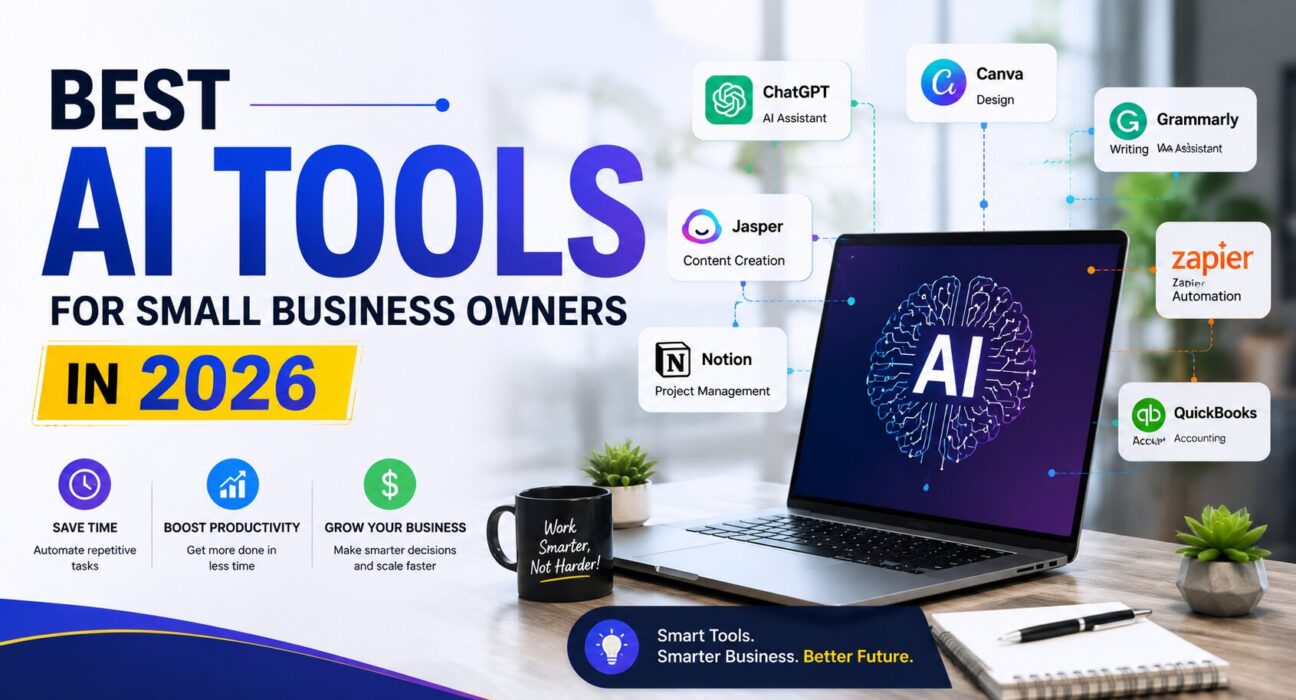
AI is no longer a luxury for big enterprises. Here’s the definitive guide to the ai tools that will actually save you time, money, and sanity this year.
Running a small business in 2026 means wearing every hat – marketer, accountant, customer support agent, and strategist, all before lunch. The good news? AI has quietly become the best employee you never had to hire. But with hundreds of tools flooding the market, knowing which ones are actually worth your money is the real challenge.
This guide cuts through the noise. We’ve organized the best AI tools by what they do for your business – not just what’s trending – so you can build a lean, powerful stack that fits your workflow.
Writing & Content Creation
Claude (Anthropic)
From drafting client proposals and writing product descriptions to answering complex business questions, Claude is a genuinely useful thinking partner. It handles nuance well, stays on-brand, and produces long-form content that doesn’t sound robotic.
Jasper AI
Jasper remains a go-to for marketing teams who need high-volume, brand-consistent copy. Its campaign templates, brand voice controls, and integrations with marketing platforms make it particularly strong for businesses with active content pipelines.
Customer Support & Communication
Intercom Fin
Intercom’s AI agent, Fin, resolves the majority of customer queries without human intervention. It learns from your help docs and past conversations, meaning the more you use it, the better it gets. For small businesses, this translates directly into fewer late-night support tickets.
Tidio AI
Tidio combines live chat with AI automation at a price point that makes sense for solo operators and small teams. Its Lyro AI can handle multi-turn conversations and integrates smoothly with Shopify, WordPress, and most CRM tools.
Finance & Operations
Durable
Durable bills itself as an AI small business platform — combining website building, invoicing, CRM, and marketing tools in one place. It’s especially useful for service-based businesses (consultants, tradespeople, freelancers) who need a professional presence without a dedicated ops team.
Digits
Digits is a modern AI-powered accounting platform that goes beyond bookkeeping. It generates financial narratives – plain-language summaries of where your money went, why your margins changed, and what needs your attention. Think of it as a CFO who never sleeps.
Productivity & Workflow Automation
Zapier AI
Zapier’s AI layer lets you describe automations in plain English and have them built for you. “When a new lead comes in via the website form, add it to my CRM, send them a welcome email, and notify my Slack channel” – done in seconds, no coding required.
Notion AI
If your business runs on documents, SOPs, and knowledge bases, Notion AI is a powerful addition. It can summarize meeting notes, generate project briefs, answer questions from your internal wiki, and even draft first versions of complex documents – all inside your existing workspace.
Visual & Creative
Adobe Firefly (for Business)
Adobe’s commercial-safe AI image generator is now deeply integrated into Photoshop, Illustrator, and Express. For small businesses that need branded visuals without a dedicated designer, Firefly is the most practically useful image AI – especially since everything it generates is licensed for commercial use.
Canva AI (Magic Studio)
Canva’s Magic Studio suite has matured into a comprehensive AI design toolkit. Magic Write, Magic Design, and AI-powered video generation mean non-designers can produce professional-quality materials in minutes. The template depth and brand kit features make it uniquely suited for small business owners.
How to Choose Building Your AI Stack
You don’t need every tool on this list. A well-chosen stack of three to five tools will outperform a chaotic collection of twenty. Here’s a practical framework for deciding what to adopt first:
- Start with time audits. Identify the three tasks that steal the most hours from your week. AI should target those first – not novelty tasks you don’t actually do often.
- Prioritize ROI over features. A tool that saves you three hours a week at $30/month is a far better investment than a $200/month platform you use occasionally.
- Test before committing. All of the tools here have a free trial or free plan. Use it for a minimum of 1 week before switching to a paid subscription. The ability to be used in real-life scenarios, integrated with other applications, and compatible with the workflow is more important than slick demo videos.
- Automate repeatable tasks first. AI is most valuable when it handles the predictable – not the creative judgements only you can make. Let it draft; you decide and refine.
- Review quarterly. The AI landscape moves fast. A tool that was best-in-class six months ago may have been overtaken. Schedule time every quarter to reassess your stack.
The businesses that will thrive in the next few years are not the ones with the biggest budgets or the largest teams – they’re the ones that figure out how to move faster and think smarter. AI won’t replace the judgment, relationships, and creativity that make your business yours. But it will handle everything else, if you let it.
Pick one tool from this list, spend a week with it, and notice what changes. That’s where it starts.